

Acupressure and Spiked Mats: How to Stimulate Endorphin Release in the Comfort of Your Home
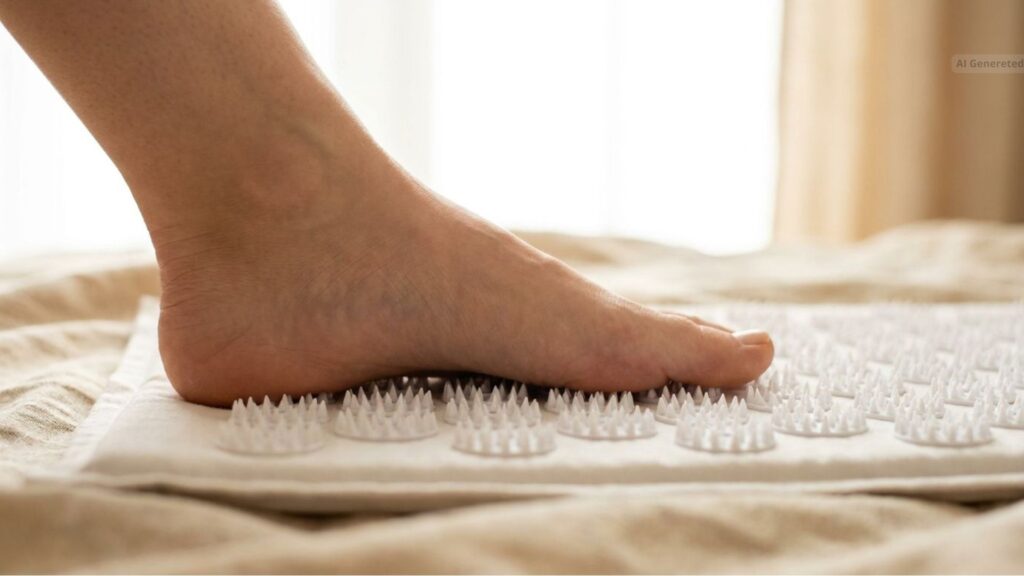
Some days the pain is so intense you reach for a pill, and it's good to have one. But there are also days when you're looking for something gentler, something you can do yourself at home, without a prescription and without side effects. Acupressure mats and targeted pressure on specific points are tools that a growing number of women with endometriosis are incorporating into their daily routine to manage discomfort. While they don't replace specialized treatment, they can make a real difference in how you feel between doctor visits.
Why does pressure work? The mechanism in a few sentences.
When the mat's spines or fingers apply pressure to the skin and underlying tissues, the nervous system interprets this stimulus as a strong but controlled sensory signal. In response, the body activates several interdependent biological mechanisms.
The first is the pain gate theory, described by Melzack and Wall in 1965. It posits that the spinal cord processes sensory signals through a specific gate. When a strong tactile stimulus and a pain signal reach the spinal cord simultaneously, the tactile sensation can partially block the transmission of pain information to higher levels of the nervous system. The pressure of the mat's spikes provides precisely this intense tactile signal, effectively competing with the pain signals flowing from the pelvis.
The second mechanism is the stimulation of endorphin and oxytocin release. Intense, widespread pressure on the skin stimulates mechanical receptors, which send signals directly to the hypothalamus and pituitary gland. This results in a release of endorphins, natural opioids produced by the body, and oxytocin, which has a relaxing effect on smooth muscles and has its own analgesic properties. This is why many women describe a characteristic feeling after a few minutes on the mat: a slight numbness of the skin, a pleasant warmth spreading throughout the body, and a noticeable relaxation of tissue tension.
The third element is its influence on the autonomic nervous system. Regular contact with the mat, especially in the evening, shifts the autonomic balance toward the parasympathetic nervous system, which is responsible for rest, regeneration, and digestion. Lower sympathetic nervous system tone translates into lower cortisol levels, easier falling asleep, and less overall reactivity to painful stimuli.
Acupressure mat – how to use it safely?
An acupressure mat, also known as a Kuznetsov applicator or a Pranamat-style spiked mat, is a surface covered with sharp protrusions that apply widespread pressure to a large area of the body simultaneously. Although it doesn't pierce the skin, the first few seconds of contact can be very intense. To ensure safe use and achieve the desired results, it's worth following a few practical rules.
It's best to do your first sessions through a thin cotton T-shirt. Direct skin-to-mat contact is much stronger and can be gradually increased as tissues adapt. Some women prefer to use the mat through clothing at all times, which is a completely valid and effective approach.
Start with ten minutes and carefully observe your body's reaction. The optimal session length is usually fifteen to twenty minutes, but your body will tell you the right time to end. A burning sensation at the beginning is natural and usually gradually transitions into a pleasant warmth and relaxation.
The best position for endometriosis is lying on your back with a mat placed under your lower back and buttocks. This position relaxes the paraspinal muscles, pelvic floor, and the backs of the thighs, where tension can be particularly intense. You can also combine the mat with the Viparita Karani (legs up on the wall) position, which further reduces passive congestion in the pelvic area.
Avoid placing the mat directly under your abdomen while in the prone position, especially if you have active peritoneal masses or ovarian cysts. Direct pressure on this area may exacerbate the pain rather than relieve it.
An evening session before bed is one of the best times to regenerate. The combination of muscle relaxation, oxytocin release, and activation of the parasympathetic nervous system helps calm an overstimulated nervous system and facilitates falling asleep, which can be a significant challenge with chronic pain.
Acupressure points worth knowing
Acupressure, unlike mat therapy, involves the targeted, pinpoint pressure on specific areas of the body using fingertips or special tools. It requires no equipment and can be applied anywhere. Several points deserve special attention in relieving pelvic tension.
The SP6 point, called Sanyinjiao in traditional Chinese medicine, is located on the inner aspect of the shin, four fingerbreadths above the medial malleolus, just behind the edge of the shinbone. This is one of the most commonly used points for menstrual pain and lower abdominal tension. Pressure should be firm but tolerable, applied for one to two minutes on each leg. It is important to note that this point is strictly contraindicated during pregnancy , as it is believed to stimulate uterine contractions.
The LV3 point, called Taichong, lies on the dorsum of the foot in the depression between the first and second metatarsals, approximately two centimeters from the skin ridge between the big toe and the second toe. Its stimulation is associated with the release of pelvic tension, emotional regulation, and the reduction of painful spasms.
The PC6 point, or Neiguan, is located on the inside of the wrist, three fingers above the wrist crease, between the tendons. It is a classic point used for nausea, which often accompanies severe pain episodes, as well as for general anxiety and tension.
The KD1 point, known as Yongquan, is located on the sole of the foot, in the depression formed by flexing the toes, in the upper third of the foot. Pressure on this point has a calming effect on the nervous system and helps with insomnia associated with chronic discomfort.
Each of these points should be pressed for one to two minutes with moderate force, using small circular motions or maintaining steady pressure. You can use your thumb, the pad of your index finger, or a wooden acupressure stick. The sensation should be between pleasant pressure and relief, without sharp pain.
When to give up the mat and acupressure?
Enthusiasm for natural methods of support does not absolve us from a calm assessment of our health situation. There are times when pressure stimulation is not advisable.
In the acute phase of pain flare-ups, when the pain is exceptionally severe, radiating, or accompanied by other disturbing symptoms , the priority is to immediately consult a doctor rather than experiment with the mat. In such a situation, a strong stimulus to the pelvic area can unnecessarily intensify the body's stress response.
After laparoscopic surgery, you should wait until the trocar wounds have fully healed before using the mat. This usually takes four to six weeks, depending on the extent of the procedure.
With active ovarian endometriomas, positions that exert pressure on the ovarian area should be avoided. Direct pressure on the tissue containing cysts is contraindicated.
Use of the mat is also contraindicated for those with skin inflammation, open wounds, rashes, or dermatological lesions in the area of intended contact. Individuals taking anticoagulant medications should consult a physician before beginning a session, as intense pressure may cause bruising. If you have an implanted vascular port or pacemaker, avoid the area around the device.
How to build these tools into your daily routine?
Acupressure mats and pressure points work best as a regular supportive practice, not just as a one-time rescue. A few minutes in the evening with the mat under the lumbar spine, a moment with the SP6 point while reading a book, or pressing the PC6 point when stress increases are activities that accumulate their positive impact over time.
You don't have to implement all methods at once. Choose one tool, try it for a few weeks, and observe your body's reactions. Endometriosis is a very individual condition, so you have every right to experiment within safe limits and choose only what brings you real relief.
Sources
Armor M, Ee CC, Habek D. Acupuncture and acupressure for premenstrual syndrome. Cochrane Database of Systematic Reviews, volume 2018, number 8, pages CD005290, August 2018.
Melzack R, Wall PD. Pain mechanisms, a new theory. Science, volume 150, number 3699, pages 971, November 1965.
Smith CA, Armor M, Lee MS. Acupuncture for dysmenorrhea. Cochrane Database of Systematic Reviews, Volume 2016, Number 4, Pages CD007854, April 2016.
Uvnäs-Moberg K, Handlin L, Petersson M. Self-soothing behaviors with particular reference to oxytocin release induced by non-noxious sensory stimulation. Frontiers in Psychology, volume 5, pages 1529, January 2015.
ESHRE Endometriosis Guideline Development Group. Endometriosis, guideline of the European Society of Human Reproduction and Embryology. ESHRE Guidelines Office, Central Building, Grimbergen, January 2022.
